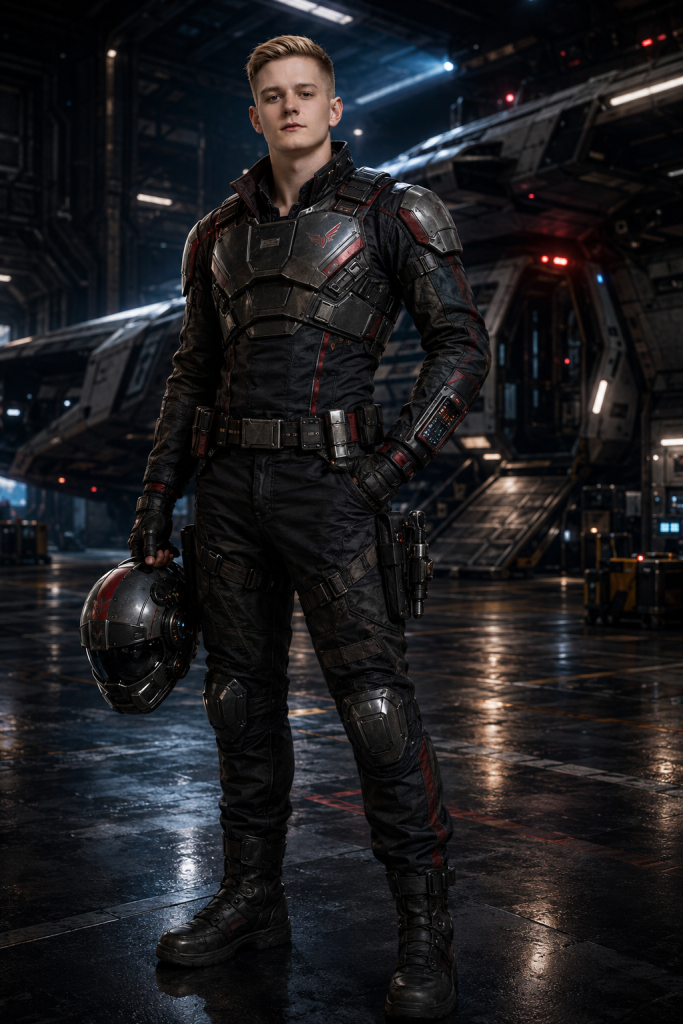
Cormus brought the Reach through the Dutchman’s shuttlebay doors considerably faster than regulations would have approved of, which was one of several reasons he remained grateful there was nobody aboard whose entire job consisted of enforcing regulations. The support craft crossed the threshold cleanly, settled onto the deck with barely a bounce, and gave a faint shudder as the landing clamps took hold.
“See?” Cormus told the console while beginning the shutdown sequence. “Completely professional.”
The Reach offered no opinion, which he chose to interpret as agreement.
He killed the impulse engines and let the remaining systems begin cycling down around him. For the first time since leaving the Dutchman, there was nothing immediately in front of the cockpit that required his full attention. No narrowing Borg passage. No half-lit junction waiting beyond the range of the sensors. No looming wall of machinery demanding that he decide whether the gap ahead was actually wide enough or merely looked wide enough because the cube was interfering with half the instruments.
Just the shuttlebay.
Cormus sat there for a few seconds longer than he needed to.
He had flown through wrecks before. Asteroid tunnels, damaged stations and cargo structures with clearances so tight that whoever entered the dimensions into the navigation database deserved personal insults. Those places had never bothered him quite the way the cube did. A wreck was dead metal. An asteroid was a rock. Even a failing station generally had the decency to behave like something broken.
The cube had felt different.
Most of what he passed had been dark and apparently lifeless, but he had never been able to completely shake the sense that he was flying through something rather than simply inside it. Maybe that was imagination. Maybe knowing what the Borg were made it impossible to look at their technology without assigning intent to every flicker of green light and every sensor return that appeared where it should not have been.
He preferred imagination.
“Enough of that” Cormus muttered, unfastening his harness.
He climbed out of the cockpit and dropped to the deck before turning back toward the Reach. The first walk around the craft was quick, mostly habit after any flight that had pushed the maneuvering systems harder than normal. Hull integrity looked good. No visible scoring. Nothing hanging loose that had not been hanging loose when he left, which on the Reach counted as an encouraging engineering report.
The port maneuvering package had run hotter than he liked during one of the tighter turns, so Cormus crouched beside the access panel and pulled up the diagnostic. The temperature curve had climbed sharply before settling back down once the corridor opened.
He stared at it for a moment.
“Of course you did.”
The system was still within tolerance, but he reset the regulator and ran another low-power diagnostic anyway. The numbers stabilized almost immediately. Cormus watched them for a few seconds, satisfied himself that nothing had been damaged during the run, then closed the panel.
That left the more important part.
The route.
Cormus climbed back into the cockpit and pulled up the recorded flight data. The Reach had logged the entire scouting run from the Dutchman through the breach and into the junctions beyond, although sections of the sensor record were as ugly as he remembered. Borg interference had distorted range readings in several places, and there were stretches where the computer had relied as much on inertial tracking as the external sensors.
Fortunately, Cormus had been paying attention.
He cleaned up the route manually, marking the tighter turns, the areas where the sensors had become unreliable, and the junction where the Dutchman would have enough room to maneuver if they decided to take her farther in. He added notes for the sections where the Reach had needed to slow almost to thruster speed and flagged one passage that looked navigable on the raw scan but had been considerably narrower once he actually reached it.
That one earned a particularly blunt warning.
**DO NOT TRUST SENSOR WIDTH.**
Cormus looked at it and added:
**SERIOUSLY.**
Better.
He saved the revised route to the Reach, sent a copy into the Dutchman’s navigation system, then transferred the raw scouting data separately so anyone who wanted to argue with his interpretation could enjoy staring at the same mess he had spent the last several minutes flying through.
Only then did he lean back.
The cube remained around them, impossibly large even though most of it could not be seen from inside the Dutchman. Somewhere beyond the shuttlebay walls stretched the route he had just flown, followed by more passages, more junctions and eventually whatever had convinced Zedd that putting their ship inside a Borg cube was preferable to remaining outside it.
Cormus rubbed a hand across his face.
He had volunteered for the scouting run.
That seemed worth remembering.
A brief laugh escaped him as he stood again. “Idiot.”
The word carried no real regret.
Whatever waited deeper inside, they had a way in now. More importantly, they had a way back. Cormus had seen the route with his own eyes, flown it once, and knew where the worst sections were. If they needed the Reach again, the second trip would be faster.
He powered down the remaining cockpit systems and stopped at the hatch before stepping out.
For a moment his usual grin disappeared as he looked back toward the darkened controls.
The jokes were easier while he was flying. They gave his mind something harmless to do between decisions that actually mattered. Sitting still afterward was when the details tended to catch up with him. The turns where the clearance had been closer than expected. The light he had seen somewhere farther down one passage. The occasional sensor return that had appeared and disappeared before the computer could identify it.
None of that had followed him back, as far as he knew.
Cormus stepped onto the shuttlebay deck and sealed the Reach behind him.
Tomorrow could worry about what came next.
♥ 0